Frequently asked questions about trust and AI
What does building trust with AI mean?
Building trust with AI means creating confidence that AI is being used responsibly, transparently, and effectively across the organization. Trust is not built through technology alone. It develops when employees understand why AI is being introduced, how it supports organizational goals, and what role they play in using it. This includes establishing governance, providing education, defining expectations, maintaining accountability, and ensuring appropriate human oversight.
Employees need to understand not only what AI can do, but also its limitations. They should know when AI can help accelerate work, where additional review is required, and who remains responsible for decisions and outcomes. When people have this clarity, they are more willing to adopt AI, integrate it into daily workflows, and use it confidently. Over time, trust becomes a critical foundation for responsible adoption, organizational transformation, and long-term value creation.
Why is trust important for AI adoption?
Trust is one of the most important factors influencing AI adoption. Employees are more likely to experiment with new tools, incorporate them into their daily work, and share successful practices when they trust both the technology and the organization's approach to using it. Simply providing access to AI tools rarely results in meaningful transformation on its own.
Employees need confidence that AI is being introduced thoughtfully, that clear guardrails exist, and that leadership is committed to responsible use. Without trust, employees may limit their use of AI to basic tasks or avoid it altogether due to uncertainty about risks, expectations, or accountability. When trust exists, adoption becomes more sustainable. Employees are more willing to explore new possibilities, learn from experience, and contribute to broader organizational progress, helping AI become an embedded capability rather than a short-term initiative.
How can leaders build trust with AI?
Leaders can build trust by communicating consistently, establishing clear expectations, and modeling responsible AI use. Employees often look to leadership for guidance when new technologies are introduced. When leaders clearly explain why AI matters, how it supports business objectives, and what success looks like, uncertainty begins to decrease.
Trust also grows when leaders are transparent about both opportunities and risks. Rather than presenting AI as a perfect solution, effective leaders acknowledge limitations and reinforce the importance of human judgment. Investing in education, encouraging questions, and providing opportunities for practical experimentation can further strengthen employee confidence. Most importantly, leaders should demonstrate accountability in their own decision-making.
What is the relationship between trust and enterprise value?
Trust creates the conditions necessary for organizations to move from AI experimentation to measurable business outcomes. While technology may create new capabilities, those capabilities only generate value when people use them consistently and effectively. Trust encourages employees to adopt AI, apply it to meaningful work, and continue learning as technology evolves.
Organizations with strong AI trust are often better positioned to identify efficiencies, improve decision-making, foster innovation, and strengthen collaboration. Trust also helps reduce friction that can slow adoption, such as hesitation, uncertainty, or inconsistent use across teams. As AI becomes increasingly integrated into business processes, trust serves as a catalyst that connects technology investments to operational improvements and strategic outcomes.
How can organizations build employee trust in AI?
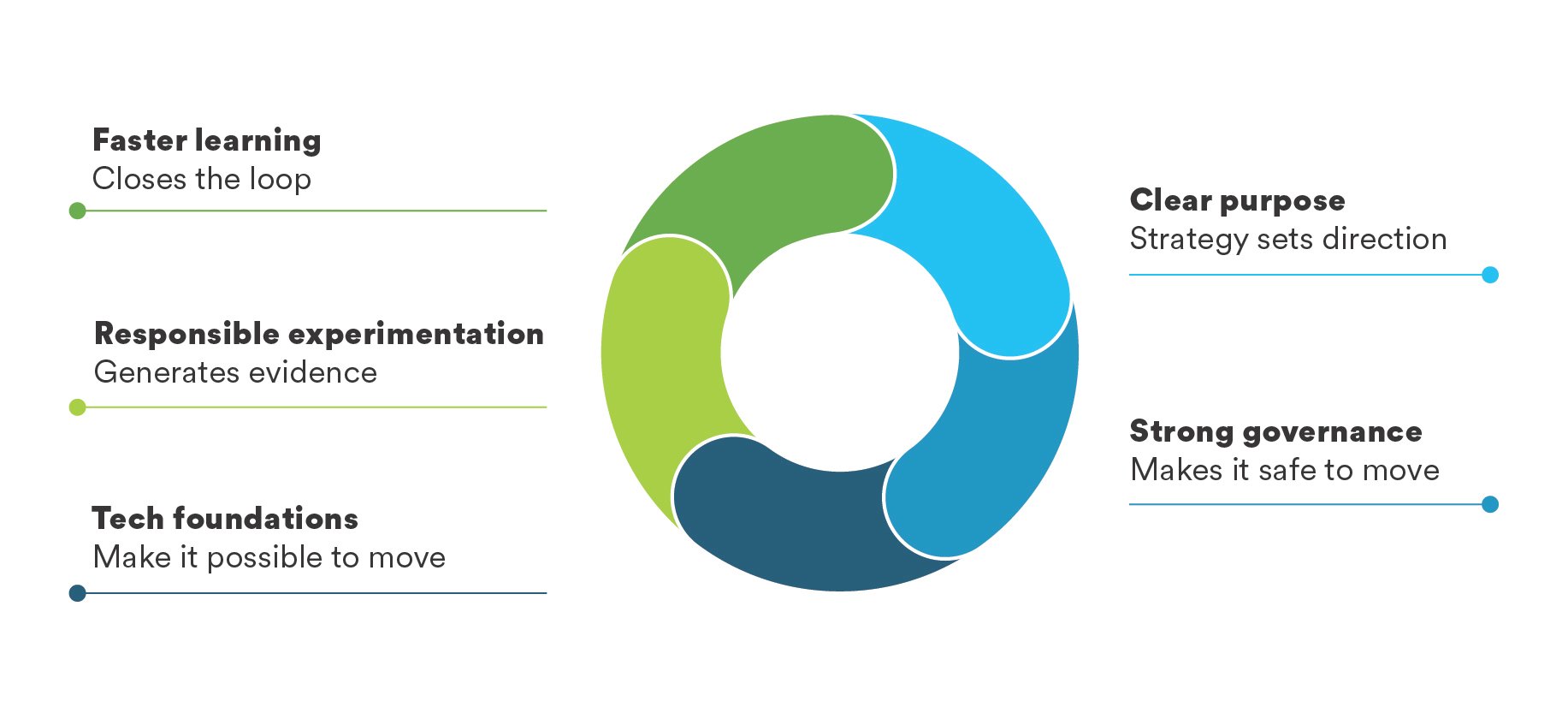
Organizations can build employee trust in AI by creating clarity, consistency, and practical experience. Employees should understand why AI is being introduced, how it aligns with organizational objectives, and what benefits it can provide to their daily work. Clear communication helps reduce uncertainty and creates a stronger foundation for adoption.
Trust also develops through hands-on experience. Training programs, real-world use cases, peer learning opportunities, and guided experimentation help employees build confidence over time. Organizations should clearly define approved tools, governance requirements, and expectations for responsible use. Reinforcing accountability and providing access to support resources can further strengthen confidence.
How does AI governance help build trust?
AI governance helps build trust by providing a clear framework for responsible use. Employees are more likely to adopt AI when they understand the rules, expectations, and safeguards that guide its use across the organization. Effective governance reduces uncertainty and provides clarity around accountability, data handling, security, risk management, and human oversight.
Governance should not be viewed solely as a risk-control mechanism. It also serves as an enabler of adoption by giving employees confidence to experiment within defined boundaries. When governance frameworks are practical, understandable, and consistently applied, employees have a clearer understanding of what is permitted and where additional guidance may be needed. Consistent standards across teams help build confidence that AI is being implemented responsibly. Over time, governance becomes an important foundation for scaling AI adoption while maintaining trust and accountability.
How can companies encourage responsible AI experimentation?
Responsible experimentation begins with creating an environment where employees feel empowered to test new approaches while operating within clear boundaries. Employees should understand where experimentation is encouraged, what safeguards need to be followed, and when additional review or approval is required.
Organizations can support experimentation by sharing successful use cases, creating opportunities for collaboration, and reinforcing lessons learned from both successes and failures. The goal should not be experimentation for its own sake, but rather experimentation that helps solve meaningful business challenges. Clear governance, practical guidance, and ongoing support help employees explore new possibilities without creating unnecessary risk. When accountability remains clear and learning is encouraged, experimentation can strengthen organizational capabilities, accelerate adoption, and help identify innovative ways to create value through AI.
How should organizations measure AI adoption and trust?
Organizations should measure AI adoption and trust using a balanced combination of quantitative and qualitative indicators. Usage metrics can provide useful insights into whether employees are engaging with available tools, but activity alone does not necessarily indicate successful transformation.
Leaders should also evaluate whether AI is improving business outcomes, reducing friction in workflows, increasing productivity, supporting innovation, or enhancing client experiences. Surveys, interviews, and employee feedback can provide additional insight into confidence levels, understanding of governance, and perceived value. Looking at both behavior and sentiment helps organizations gain a more complete picture of progress. Ultimately, the most meaningful measurements connect adoption to organizational objectives and demonstrate that AI is helping create sustainable value rather than just generating activity.
What prevents employees from trusting AI?
Several factors can limit employee trust in AI. One of the most common is a lack of clarity around why AI is being introduced and how it will affect daily work. Uncertainty about expectations, accountability, or appropriate use can create hesitation and slow adoption.
Trust may also be weakened when employees receive inconsistent messages, lack access to education, or feel unprepared to evaluate AI-generated outputs. Concerns about transparency, data use, and potential risks can further contribute to skepticism. In some organizations, employees are given access to AI tools without sufficient guidance on how to use them effectively. Building trust requires addressing these challenges directly. Employees are more likely to embrace AI when they understand its purpose, feel supported in learning, and have confidence in the governance structures that guide responsible use.