Building trust with AI: The foundation of enterprise transformation

October 2, 2026
13 MIN READ 13 MIN READ
Sneha_Shah

Chief AI Strategist and Head of SEI Next

Building trust with AI is the foundation for turning employee adoption into lasting enterprise value.

AI potential is everywhere. New models appear constantly. Teams can generate content, summarize meetings, write code, analyze documents, answer operational questions, and automate workflows faster than many organizations thought possible.

And yet, many organizations still struggle to convert access into lasting business value. Technology is advancing quickly. Enterprise transformation is moving more slowly. The gap is not simply a technology gap. It is a trust gap.

Organizations often approach trust as a governance exercise that follows implementation. In practice, trust is the layer that determines whether people will use AI, rely on it appropriately, challenge it when needed, and make it part of how work actually gets done.

At SEI, trust became the foundational layer in our journey from AI ambition to enterprise value. During our company-wide rollout of Microsoft 365 Copilot, more than 90% of employees engaged with Copilot, generating  over 2.8 million actions within the first year. Those metrics are not enterprise value in themselves, but they are evidence that people were willing to engage with AI and begin building new habits around its use. 

The level of adoption was not driven by access alone. It was made possible by the confidence, clarity, and accountability people need to incorporate AI into their day-to-day work. Without that foundation, transformation never begins.

That’s why trust is not the byproduct of successful AI implementation. Trust is what makes successful AI implementation possible.

Why AI requires a new foundation of trust

AI changes the relationship between people, work, and judgment because it generates recommendations and outputs that still require human evaluation and accountability.

Most enterprise technology has been designed around predictable processes. A system stores information, routes work, applies rules, or completes a defined task. People build confidence because the system behaves in expected ways.

AI changes that relationship. It generates, recommends, summarizes, predicts, drafts, and reasons across information. That creates new possibilities, but it also introduces a different kind of responsibility. People must know when to use AI, how to evaluate its output, when to challenge it, and where human judgment must remain accountable.

This is one reason why AI adoption often lags, or even fails, even when technology works.

People are not simply learning a new interface. They are learning a new working relationship with systems that can produce useful, flawed, incomplete, or confidently incorrect outputs.

The goal is informed confidence: a shared understanding of where AI fits and how humans remain accountable. 

That is why AI adoption cannot be managed like a standard software rollout. The strategic question for leaders is no longer, “Do we have AI tools available?” The better question is, “Do our people trust themselves, our systems, and our operating model enough to use AI responsibly at scale?"

Trust as a strategic AI capability

Trust is a strategic AI capability because it gives employees the clarity, confidence, and accountability to use AI responsibly.

Trust is often discussed as a governance requirement. In practice, it is one of the most important strategic capabilities organizations will need as AI becomes more deeply embedded in how work gets done. 

As intelligence becomes more abundant , trust becomes more valuable. Trust enables people to act on intelligence, helps leaders move faster with confidence, and creates the foundation for responsible AI adoption. In practice, trust exists across three dimensions:

  • Trust in leadership: Understanding why AI matters, how decisions will be made, and what it means for the future of work
  • Trust in the system: Having confidence that AI is being used responsibly, with clear governance, accountability, and boundaries
  • Trust in themselves: Feeling confident using AI effectively, applying judgment, and knowing when to challenge the output
colleagues-supporting-trusting

Organizations that build all three forms of trust are better positioned to turn experimentation into adoption, adoption into transformation, and transformation into measurable value. 

Why transparency is essential to employee trust in AI

Trust becomes difficult to establish when people receive mixed signals. Leaders may describe AI as a tool to augment human potential while markets, investors, and media narratives focus on efficiency gains and workforce reduction. People notice the contradiction.

The most effective organizations are not those with every answer. They are the ones that communicate openly about what they know, what they do not know, and how decisions will be made as the technology evolves. Trust grows when organizations reduce uncertainty through transparency rather than optimism.

How trust turns AI adoption into enterprise value

Trust creates enterprise value by helping organizations learn faster, make better decisions, scale expertise, reduce friction, and improve outcomes.

Many AI discussions focus on productivity. Productivity matters, but enterprise value comes from something larger. 

Trust accelerates organizational learning

Trust accelerates learning. When people understand the systems available to them, they are more willing to experiment responsibly, surface limitations, and share what they learn. Over time, those learning loops help organizations identify stronger solutions, improve operational quality, and uncover opportunities that would otherwise remain hidden.

Trust enables responsible AI at scale

Trust enables responsible scale. Many organizations can launch pilots. Fewer can scale AI across the enterprise with consistency and accountability. Strong governance helps create that consistency by giving people a common framework for acceptable use, risk awareness, and escalation.

Trust makes human judgment a business advantage

Trust turns human judgment into a business advantage. AI can expand capacity, but it does not remove accountability. The more AI enters decision-making, service, operations, and knowledge work, the more valuable human expertise becomes. At SEI, one of the most important messages throughout our journey was simple: AI should enhance human judgment, not replace it.

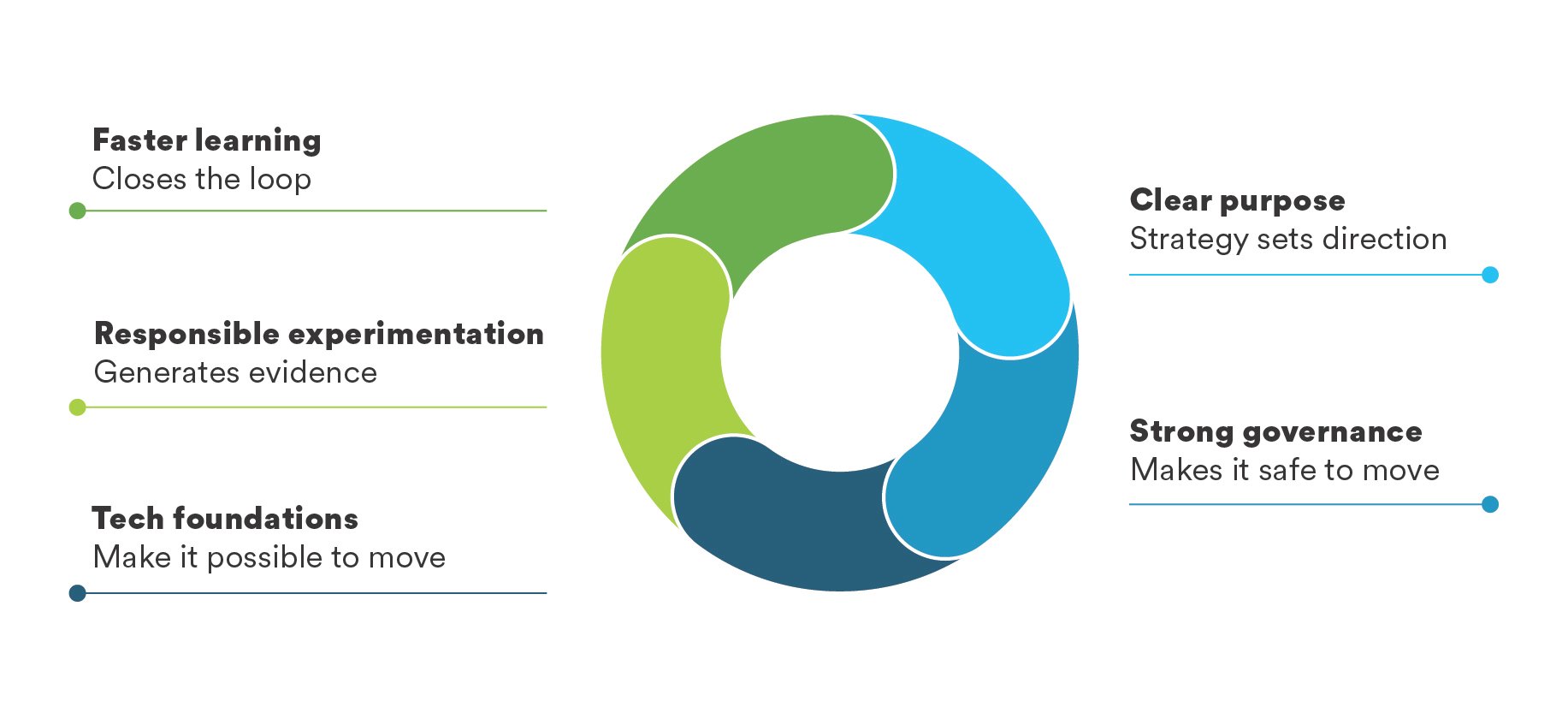
Compounding AI capability: A trust-powered cycle

This cycle begins with trust. People need confidence in the systems, governance, and ways of working before they will engage. As outcomes improve, trust grows, creating a reinforcing cycle that accelerates learning and capability.

Frontify Image
260193.15_CRP_Sneha AI Series blog post 1_PR3

Output energy: What it produces

  • Better decisions. Evidence replaces instinct at the point of choice.
  • Measurable enterprise value. Benefit tracked to the P&L, not to pilot counts.
  • Greater trust & human confidence. People rely on the system because it consistently delivers value, strengthening the foundation for the next wave of adoption and learning. 

What SEI has learned about building employee trust in AI

One of the most important lessons from SEI's journey is that AI adoption is not primarily a technology challenge. It is a human challenge, and trust is at the center of it.

Early in our journey, like many organizations, we focused heavily on access. We wanted to put an AI tool in employees' hands and remove barriers to getting started. What we quickly learned, however, was that access alone does not create sustained adoption. 

Why access alone does not lead to sustained AI adoption

The real challenge was helping people build the confidence and capability to use AI effectively in their day-to-day work. That realization shifted our focus beyond technology to education, experimentation, and practical application. We found that people learned best through hands-on experiences and adopted AI more readily when they could connect it to work that mattered to them.

We also learned that trust grows through evidence. As teams shared meaningful outcomes, skepticism turned into curiosity, curiosity into experimentation, and experimentation into momentum.

The lesson was simple: 

Access starts the journey, but confidence and capability sustain it. When people trust themselves, not just the technology, adoption becomes meaningful and transformation becomes possible.

Access starts the journey, but confidence and capability sustain it. When people trust themselves, not just the technology, adoption becomes meaningful and transformation becomes possible.

Five questions leaders should ask about AI trust

Leaders should evaluate whether their organization has a trust strategy strong enough to support responsible AI adoption at scale. Leaders can start with five questions:

How to assess your organization’s readiness for trusted AI adoption

  1. Are employees clear on why AI matters and how it connects to business outcomes, client needs, risk management, operational effectiveness, and personal growth?
  2. Have we defined where AI can contribute, where human oversight remains essential, and where AI should not be used?
  3. Are we measuring transformation, not just usage, by looking at decision-making, collaboration, learning, operating effectiveness, client experience, and speed to value?
  4. Are we creating conditions for responsible learning, where experimentation is encouraged, responsible use is reinforced, and lessons are shared?
  5. Are we treating trust as a scaling mechanism that helps the organization move faster without losing accountability?

How organizations can operationalize trust

The leaders who create the most value from AI will not simply focus on deploying tools. They will focus on building clarity around how decisions are made, accountability for how technology is used, and confidence in when human judgment should lead. Those capabilities allow organizations to adapt as technology evolves without continuously rebuilding trust.

In that sense, trust is not the destination of an AI strategy. It is the operating condition that makes an AI-enabled organization possible.

As intelligent systems become more capable, the challenge for leaders will shift from managing technology to stewarding decision-making, accountability, and human potential at scale. Organizations that recognize that shift early will be better positioned to learn, adapt, and compete in a world where intelligence is abundant, but trust remains earned. 

Frequently asked questions about trust and AI 

What does building trust with AI mean?

Building trust with AI means creating confidence that AI is being used responsibly, transparently, and effectively across the organization. Trust is not built through technology alone. It develops when employees understand why AI is being introduced, how it supports organizational goals, and what role they play in using it. This includes establishing governance, providing education, defining expectations, maintaining accountability, and ensuring appropriate human oversight.

Employees need to understand not only what AI can do, but also its limitations. They should know when AI can help accelerate work, where additional review is required, and who remains responsible for decisions and outcomes. When people have this clarity, they are more willing to adopt AI, integrate it into daily workflows, and use it confidently. Over time, trust becomes a critical foundation for responsible adoption, organizational transformation, and long-term value creation.

Why is trust important for AI adoption?

Trust is one of the most important factors influencing AI adoption. Employees are more likely to experiment with new tools, incorporate them into their daily work, and share successful practices when they trust both the technology and the organization's approach to using it. Simply providing access to AI tools rarely results in meaningful transformation on its own.

Employees need confidence that AI is being introduced thoughtfully, that clear guardrails exist, and that leadership is committed to responsible use. Without trust, employees may limit their use of AI to basic tasks or avoid it altogether due to uncertainty about risks, expectations, or accountability. When trust exists, adoption becomes more sustainable. Employees are more willing to explore new possibilities, learn from experience, and contribute to broader organizational progress, helping AI become an embedded capability rather than a short-term initiative.

How can leaders build trust with AI?

Leaders can build trust by communicating consistently, establishing clear expectations, and modeling responsible AI use. Employees often look to leadership for guidance when new technologies are introduced. When leaders clearly explain why AI matters, how it supports business objectives, and what success looks like, uncertainty begins to decrease.

Trust also grows when leaders are transparent about both opportunities and risks. Rather than presenting AI as a perfect solution, effective leaders acknowledge limitations and reinforce the importance of human judgment. Investing in education, encouraging questions, and providing opportunities for practical experimentation can further strengthen employee confidence. Most importantly, leaders should demonstrate accountability in their own decision-making. 

What is the relationship between trust and enterprise value?

Trust creates the conditions necessary for organizations to move from AI experimentation to measurable business outcomes. While technology may create new capabilities, those capabilities only generate value when people use them consistently and effectively. Trust encourages employees to adopt AI, apply it to meaningful work, and continue learning as technology evolves.

Organizations with strong AI trust are often better positioned to identify efficiencies, improve decision-making, foster innovation, and strengthen collaboration. Trust also helps reduce friction that can slow adoption, such as hesitation, uncertainty, or inconsistent use across teams. As AI becomes increasingly integrated into business processes, trust serves as a catalyst that connects technology investments to operational improvements and strategic outcomes. 

How can organizations build employee trust in AI?

Organizations can build employee trust in AI by creating clarity, consistency, and practical experience. Employees should understand why AI is being introduced, how it aligns with organizational objectives, and what benefits it can provide to their daily work. Clear communication helps reduce uncertainty and creates a stronger foundation for adoption.

Trust also develops through hands-on experience. Training programs, real-world use cases, peer learning opportunities, and guided experimentation help employees build confidence over time. Organizations should clearly define approved tools, governance requirements, and expectations for responsible use. Reinforcing accountability and providing access to support resources can further strengthen confidence. 

How does AI governance help build trust?

AI governance helps build trust by providing a clear framework for responsible use. Employees are more likely to adopt AI when they understand the rules, expectations, and safeguards that guide its use across the organization. Effective governance reduces uncertainty and provides clarity around accountability, data handling, security, risk management, and human oversight.

Governance should not be viewed solely as a risk-control mechanism. It also serves as an enabler of adoption by giving employees confidence to experiment within defined boundaries. When governance frameworks are practical, understandable, and consistently applied, employees have a clearer understanding of what is permitted and where additional guidance may be needed. Consistent standards across teams help build confidence that AI is being implemented responsibly. Over time, governance becomes an important foundation for scaling AI adoption while maintaining trust and accountability.

How can companies encourage responsible AI experimentation?

Responsible experimentation begins with creating an environment where employees feel empowered to test new approaches while operating within clear boundaries. Employees should understand where experimentation is encouraged, what safeguards need to be followed, and when additional review or approval is required.

Organizations can support experimentation by sharing successful use cases, creating opportunities for collaboration, and reinforcing lessons learned from both successes and failures. The goal should not be experimentation for its own sake, but rather experimentation that helps solve meaningful business challenges. Clear governance, practical guidance, and ongoing support help employees explore new possibilities without creating unnecessary risk. When accountability remains clear and learning is encouraged, experimentation can strengthen organizational capabilities, accelerate adoption, and help identify innovative ways to create value through AI.

How should organizations measure AI adoption and trust?

Organizations should measure AI adoption and trust using a balanced combination of quantitative and qualitative indicators. Usage metrics can provide useful insights into whether employees are engaging with available tools, but activity alone does not necessarily indicate successful transformation.

Leaders should also evaluate whether AI is improving business outcomes, reducing friction in workflows, increasing productivity, supporting innovation, or enhancing client experiences. Surveys, interviews, and employee feedback can provide additional insight into confidence levels, understanding of governance, and perceived value. Looking at both behavior and sentiment helps organizations gain a more complete picture of progress. Ultimately, the most meaningful measurements connect adoption to organizational objectives and demonstrate that AI is helping create sustainable value rather than just generating activity.

What prevents employees from trusting AI?

Several factors can limit employee trust in AI. One of the most common is a lack of clarity around why AI is being introduced and how it will affect daily work. Uncertainty about expectations, accountability, or appropriate use can create hesitation and slow adoption.

Trust may also be weakened when employees receive inconsistent messages, lack access to education, or feel unprepared to evaluate AI-generated outputs. Concerns about transparency, data use, and potential risks can further contribute to skepticism. In some organizations, employees are given access to AI tools without sufficient guidance on how to use them effectively. Building trust requires addressing these challenges directly. Employees are more likely to embrace AI when they understand its purpose, feel supported in learning, and have confidence in the governance structures that guide responsible use.


About this series

From AI vision to enterprise value is a practical thought leadership series for leaders navigating the realities of AI adoption—from early pilots to responsible, enterprise-wide scale. Drawing on SEI’s own AI-native journey, Sneha Shah, Chief Strategist and Head of SEI Next at SEI, goes beyond tools and models to explore how AI reshapes the way work gets done. Each installment explores the critical tradeoffs alongside the cultural and operational shifts required to turn AI ambition into sustained enterprise value while preserving human judgment.

Ideas shaping what’s next.

Practical insights on enterprise AI, data, innovation, and the forces reshaping business and technology.

Accelerate your path forward.

Connect with SEI to explore new ways to grow, evolve, and deliver lasting client value.